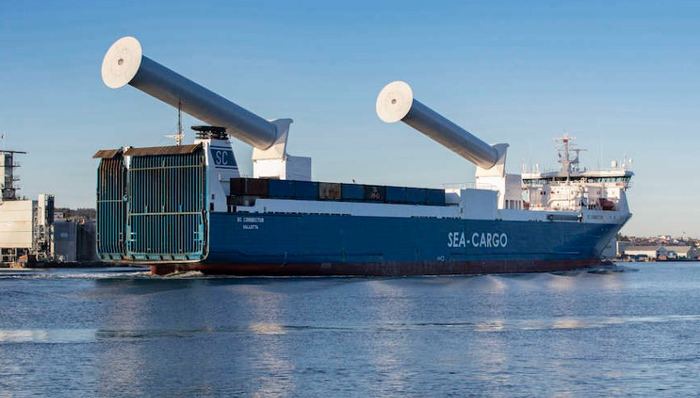
At Karmøy, on the Norwegian coast, I spent a while watching the SC Connector go about her business. The two white columns in the photograph are not funnels. They are sails.
Norsepower fitted this Sea-Cargo ro-ro with two 35-metre Rotor Sails — spinning cylinders that turn wind into thrust. The clever part is that they tilt. Her run from western Norway to the Netherlands and the UK passes under bridges and power lines, so the sails lie flat to go beneath and stand up again on the other side. They were the first tiltable set in the world.
The numbers are faintly ridiculous. In testing the pair produced the equivalent of 7 MW at the propeller shaft — more than her own main engine — and she touched 19.6 knots with the engine chipping in about 3. The crew report less roll and a schedule that survives weather which would otherwise cost them a day. One North Sea crossing saved ten tons of fuel, and a ton of fuel burned is better than three tons of CO2 — so call it thirty tons that stayed out of the air, on one trip.
I am quite sure you do not want me to explain the mathematics. Stand back and appreciate how extremely cool this is.
All right, the mathematics. You did not ask. Here it is anyway, and it is prettier than you expect.
Bernoulli — fast air is thin air
p + ½ρv² = constant
Spin a cylinder in a breeze and one side drags the air along with it while the other shoves against it. One side is quicker, so one side is thinner, and the column is pushed sideways. That is the Magnus effect — the Venturi you were thinking of is the same Bernoulli seen in a narrowing pipe; this one happens in open air. The spin is measured as circulation:
Γ = 2πR²ω
and Kutta–Joukowski turns circulation into force. Per metre of rotor, and then over the whole height H:
L′ = ρv∞Γ → L = 2πρR²ωv∞H
Read it and the ship makes sense. Thrust climbs with the square of the radius, which is why the columns are so fat; and straight in step with ω, which is why they hum. The only thing you spend is the electricity to keep them turning. Everything else is weather.
Idealised, of course — real air is sticky and the honest figure is lower. The shape of the thing is right.